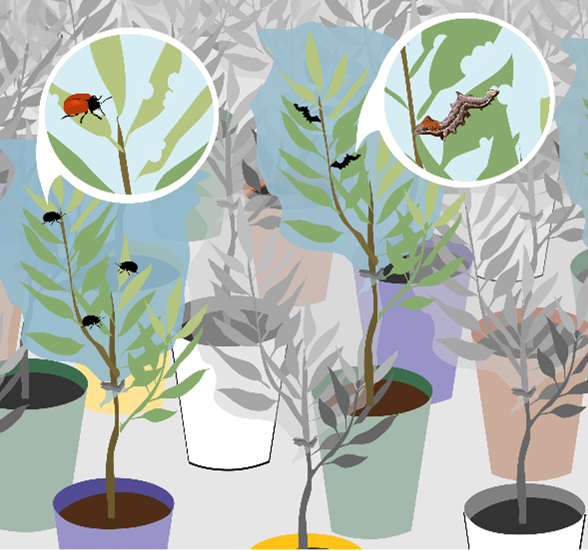
Laboratory of Evolutionary EcologyOur laboratory has a broad conceptual focus on trying to understand how extant diversity has been driven through ecological interactions over evolutionary time. We mostly work on model systems comprising plants and their associated insects, as the majority of described terrestrial species fall into these groups. Our work often includes the use of molecular and metabolomics tools to provide a baseline onto which we add layers of complexity in the form of detailed ecological measurements on communities and trophic interactions. We combine field collections with manipulative experiments and work collaboratively with others to achieve our goals. For more, see Research Projects.
NEWS |
NEW PUBLICATIONSMarinček P., Léveillé-Bourret É. , Heiduk F., Leong J.V , Bailleul S.M., Volf M., . Wagner N.D. (2024) Challenge accepted: Evolutionary lineages versus taxonomic classification of North American shrub willows (Salix). the American Journal of Botany, https://doi.org/10.1002/ajb2.16361
Leong J.V., Mezzomo P., Kozel P., Volfová T., de Lima Ferreira P., Seifert C.L., Butterill P.T., Freiberga I., Michálek J., Matos-Maraví P., Weinhold A., Engström M.T., Salminen J-P., Segar S.T., Sedio B.E., Volf M. (2024) Effects of individual traits vs. trait syndromes on assemblages of various herbivore guilds associated with central European Salix. Oecologia, 1-13. https://doi.org/10.5281/zenodo.11164786. Xiao X., Jorge L.R., Volf M., Moos M., Gélin U., Finnie S., Freiberga I., Jancuchova‐Laskova J. , Weiss M., Novotny V., Sam K. (2024) The effect of drought‐induced leaf traits on Ficus leaf palatability is species specific. Ecosphere 15 - 5, e483, https://doi.org/10.1002/ecs2.4831a Volf M., Fontanilla A.M., Vanhakylä S., Abe T., Libra M., Kogo R., Lilip R. , Kamata N. , Murakami M., Novotny V., Salminen J-P. , Segar S. T., (2024) High intraspecific variability and previous experience affect polyphenol metabolism in polyphagous Lymantria mathura caterpillars. Ecology and Evolution, https://doi.org/10.1002/ece3.10973 Volf M., Renoult S. A., Panthee S., van Dam N. M., (2024) Quantifying various aspects of chemical diversity in hybrid plants can help understanding ecological consequences of hybridization. American Journal of Botany, https://doi.org/10.1002/ajb2.16283 |